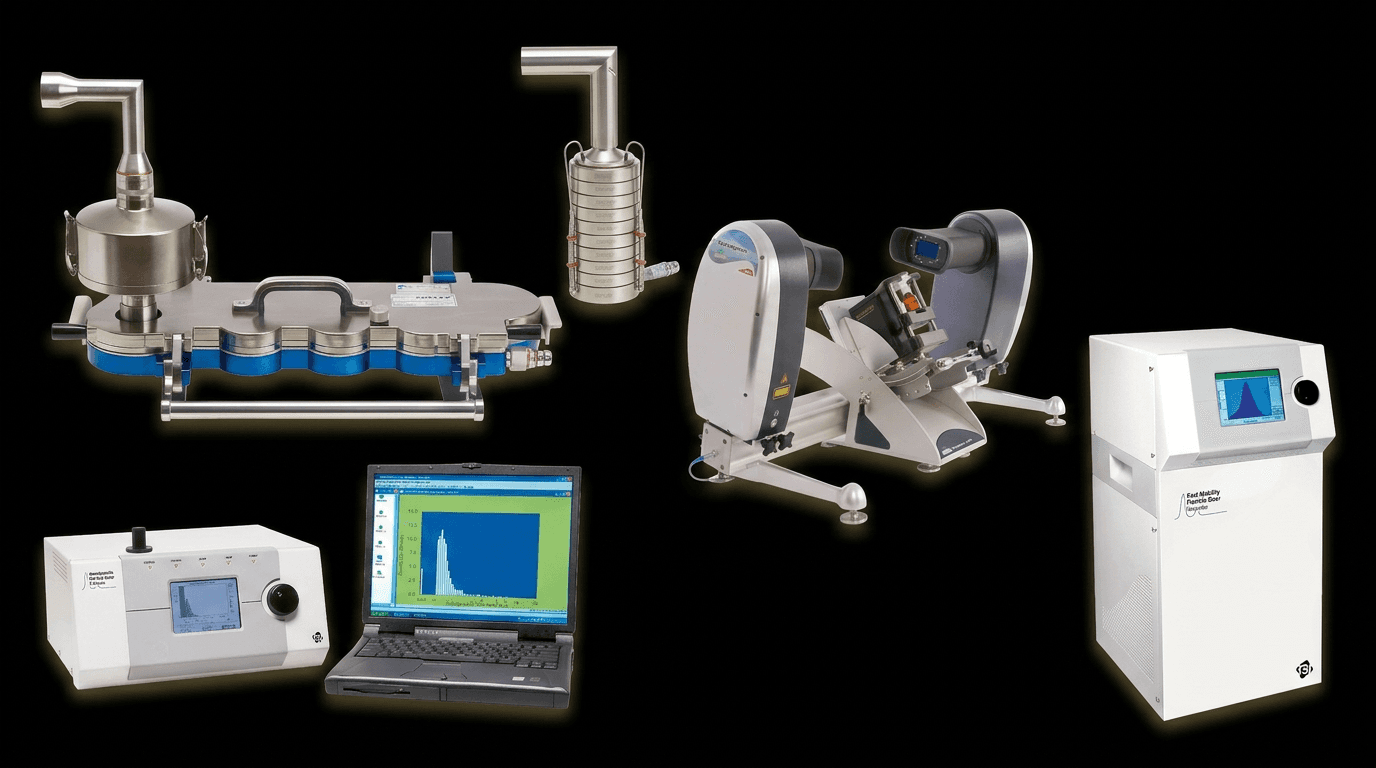
Multi-instrument PSD array — Malvern Spraytec, TSI FMPS, APS, Andersen cascade impactor, and NGI

Fig 01 · PSD instrument suite — diffraction, mobility, aerodynamic, and cascade methods.

Purpose & when to use

Particle Size Distribution (PSD) testing resolves how aerosol mass and number distribute across particle diameters — the central performance attribute behind how a drug, antimicrobial, or consumer aerosol behaves in the lung, on a surface, or through a filter. Cascade impactor methods (NGI, Andersen) deliver the regulator-aligned mass profile for MMAD and GSD under USP <601>; real-time platforms (APS, OPS, FMPS, Spraytec) add time-resolved sizing and droplet spectra. PSD is foundational for:

  1. PSD for MDIs, DPIs, nebulizers, and nasal sprays — stage-by-stage mass, MMAD / GSD, and fine-particle dose for in vitro packages under USP <601>, USP <1601>, FDA MDI / DPI / nasal.
  2. Lot-to-lot comparability and design-change control across nozzle, valve, formulation, propellant, or pump changes — predicate and reference comparisons under ICH Q5E and FDA change-control guidance, with documented statistical power and method controls.
  3. Exposure and risk assessments for consumer aerosols, antimicrobial sprays, and room-applied disinfectants — fine-fraction and ultrafine particle screening informing EPA inhalation-safety dossiers and OECD test-guideline alignment.
  4. Stability and accelerated-aging studies where particle-size drift is a critical quality attribute under USP <601>, ICH Q1A, and FDA stability guidance — supporting shelf-life justifications and container-closure decisions for inhalation products.
  5. Fogging, misting, and ULV (ultra-low volume) droplet-spectrum characterization for room-disinfection and antimicrobial-spray applications — supporting EPA registration packages, ISO 27427 nebulizing-equipment alignment, and ASTM E2647 inhalation-exposure framing.

Use PSD testing when you need defensible size-fraction data traceable to a defined method setup — controlled actuation, flow, and conditioning, with replicates, blanks, and analytical controls documented across collection and reporting so the result stands up to internal review, predicate comparison, or regulatory submission.

Built for inhalation, drug delivery, and consumer aerosols

PSD characterization spans the device categories that put particles into the air — pharmaceutical, medical, and consumer products under one analytical roof.

  • MDIMetered-dose inhalers
  • DPIDry-powder inhalers
  • NebulizerLiquid aerosol generators
  • Nasal sprayIntranasal delivery
  • Consumer aerosolSprays · fogs · disinfectants

Instrumentation & measurement ranges

We select platforms by device type, aerosol physics, and the decision the data has to support — each sizing basis answers a different question.

0.4 – 11 µmaerodynamic

Cascade impactors (NGI / Andersen)

Size-fractionated mass collection across NGI stages or Andersen cuts — the regulator-aligned basis for aerodynamic diameter, MMAD, and GSD derivation. Strong lot-to-lot comparability and the foundation for cascade extraction analytics.

0.5 – 20 µmaerodynamic

APS (aerodynamic particle sizer)

Time-of-flight aerodynamic sizing in real time — number distributions and transient plume dynamics during actuation. Useful for screening, troubleshooting, and bridging cascade data with development decisions.

0.3 – 10 µmoptical

OPS (optical particle sizer)

Optical-equivalent diameter via laser scattering with low setup overhead. Useful when refractive index is well-characterized and aerodynamic detail isn't the primary requirement — common for room-applied aerosols and consumer-product screening.

5.6 – 560 nmmobility

FMPS (fast mobility particle sizer)

Fast-mobility number distributions across the fine and ultrafine regime — captures the sub-100 nm fraction cascade impactors miss. Charge-conditioning and dilution discipline mandatory for cross-lab comparability.

0.1 – 980 µmdiffractive

Malvern Spraytec (laser diffraction)

Volume-weighted droplet spectra via laser diffraction at high throughput — screening for nasal sprays, ULV applications, and consumer-aerosol development. Refractive-index and multiple-scattering corrections applied per study.

Test method options

MethodStrengthsTradeoffAligned with
Regulator-aligned in vitro PSD (cascade impactor focus)
  • Stage-by-stage mass with derived MMAD, GSD, and fine-particle dose — from controlled actuations on NGI or Andersen impactors under documented flow.
  • Strong lot-to-lot comparability; the canonical package for inhalation submissions under USP <601>, USP <1601>, and FDA MDI / DPI / nasal guidance.
More setup and analytical work than real-time screening — best when device and formulation are locked enough to justify the cost.
USP <601>USP <1601>FDA MDI / DPI / nasal
Real-time PSD screening (APS / OPS)
  • Fast iteration with time-resolved number distributions — supports troubleshooting and rapid formulation or device screening.
  • Far less setup overhead than a cascade run — right when the program is moving and the decision is comparative, not regulatory.
Number-based sizing doesn't map directly to mass-based endpoints; bridge to cascade data when the program approaches submission.
Nanoparticle characterization (FMPS)
  • Captures the ultrafine and sub-100 nm fractions cascade impactors miss — essential when the ultrafine tail drives the safety question.
  • High time resolution (1 Hz) reveals how the ultrafine spectrum evolves through actuation, not just the integrated dose.
Requires careful charge-conditioning, neutralization, and dilution assumptions — cross-lab comparisons depend on documented method parity.
Spray droplet sizing (Malvern Spraytec)
  • High throughput for spray and nasal-product development — full droplet spectra in seconds, ideal for formulation screening.
  • Non-destructive and quick to reconfigure — pairs naturally with early device-design iteration and rapid lot comparisons.
Optical sizing basis doesn't substitute for aerodynamic measurement when regulators require mass-fraction data — bridge to cascade impactor results before submission.
ISO 27427FDA MDI / DPI / nasal
Hybrid method (cascade impactor + real-time monitor)
  • Links time-resolved plume behavior to stage-by-stage mass in a single dataset — explains what the device emits and how the emission evolves.
  • Strong framing for comparability studies where the regulator wants the dynamic explanation behind the static stage mass.
More instrumentation, synchronization, and analyst time per condition; reserve for cases where the combined view materially changes the decision.
USP <601>USP <1601>FDA MDI / DPI / nasal

Setup configurations

Every PSD study runs on a configuration matched to the device, the formulation, and the decision the data has to support. Fit-for-purpose setup balances method rigor — controlled flow, actuation, and conditioning — with the practical realities of the device under test. The dimensions below are the levers we set at study planning to keep the size distribution interpretable, reproducible, and defensible:

Device interfaces

Adapters for MDIs, DPIs, nebulizers, nasal sprays, and room-applied aerosols — geometry matched to the device under test.

Flow & actuation profiles

Controlled flow rates, actuation force and displacement, and shot counts that match the use conditions a patient or operator would apply.

Sample numbers

Replicates per condition plus method controls; power sized to device-to-device and shot-to-shot variability declared up front.

Media & handling

Coated impactor plates where applicable, extraction solvents, and documented storage for collected stages, filters, and analytical samples.

Calibration & verification

Flow meters, mass-flow controllers, and sizing instruments calibrated against traceable standards before each campaign and verified between runs.

Methods anchored to the standards that matter

Every PSD study runs inside a documented quality system aligned to inhalation, intranasal, and consumer-aerosol regulatory frames. The four anchors below define the data contract.

  • ISO 17025AccreditedTesting-laboratory competence — documented methods, calibration traceability, and uncertainty contributors.
  • USP <601>AccreditedAerosols, nasal sprays, MDIs, and DPIs — performance quality tests.
  • USP <1601>AlignedProducts for nebulization — characterization tests.
  • FDA MDI / DPI / nasalAlignedChemistry, manufacturing, and controls for inhalation and intranasal products.

Key data outputs & reporting

Every PSD study delivers a documented set of primary results plus the underlying datasets — stage-by-stage mass, derived aerodynamic metrics (MMAD, GSD, fine-particle dose), summary statistics, figures, and traceable QA / QC controls — formatted for regulatory submission, internal change-control packages, or downstream modeling. The deliverables below cover the standard PSD report; complex programs (comparability, predicate studies, stability time-courses) get an extended package with the artifacts beneath the table.

Primary outputs

  • Stage-by-stage mass from cascade impactors with derived metrics — MMAD, GSD, and fine-particle dose per actuation and per device.
  • Number or mass distributions from APS / OPS / Spraytec / FMPS with time stamps for transient plume behavior.
  • Summary statistics across replicates (mean, SD, CV) plus condition comparisons against predicate, control, or specification baselines.

Deliverables

#FormatContents
01PDF reportMethods, controls, and results tables.
02CSV / XLSX datasetsStage mass and derived metrics.
03FiguresPSD curves, overlays, and stage-mass bar charts for internal reviews and submissions.
Extended deliverables · multi-arm comparability · stability · predicate studies
  • Comparability appendixSide-by-side stage-mass overlays + statistical equivalence test per ICH Q1E or product-specific predicate framing.
  • Stability time-course packMMAD / GSD / fine-particle-dose trends across timepoints with predefined OOT criteria flagged.
  • Method-development notesDocumentation of method-selection rationale, control runs, and uncertainty contributors — for submission cover letters and inspection readiness.

QA / QC & data integrity

Every PSD study ships with a documented QA / QC envelope sized to the method plan — controls and verifications calibrated to the regulatory frame, the analytical chemistry, and the decision the data supports. The checks below run alongside size-fraction collection, audited under our ISO 17025 quality system and traceable from sample receipt through final result. Recovery, system-suitability, and environmental monitoring get added when the assay demands them.

Blanks and background runs including stage and plate blanks where applicable.

Replicate runs and device-level repeats to quantify variability across actuations, devices, and lots.

Calibration and verification logs for flow control, mass-flow controllers, and sizing instruments.

Assay controls for HPLC, ELISA, and ddPCR quantitation — calibration standards, system-suitability checks per assay, and spike-recovery on matrix-challenging analytes.

Chain of custody from sample receipt through analysis and final reporting.

Why ARE Labs

ARE Labs connects technical topics to practical study design, method selection, controlled aerosol work, and reportable evidence without turning technical pages into sales pages.

Reviewed byJamie Balarashti (25 yrs - cascade & inhalation methods) - Weston Schaper (7 yrs - real-time sizing & nanoparticle work)
17025Accredited testing
900+Studies Performed
17+Years in operation
300+Clients supported

Common questions

Quick answers to the questions inhalation, antimicrobial, and consumer-aerosol teams ask most often when scoping a PSD study — method selection, quantitation choices, replicate counts, comparability framing, and deliverables. The answers below are starting points, not protocols; reach out if your device, formulation, or regulatory frame doesn't match what's here, since most PSD studies need at least one custom configuration choice that's easier to walk through on a call than to anticipate in a FAQ.

Q.Which PSD method should I choose?
A.Use cascade impactors when you need size-fraction mass and derived aerodynamic metrics — MMAD and GSD. Use APS, OPS, or Spraytec for faster development screening; FMPS when the sub-100 nm fraction matters. We match method to decision during study planning.
Q.Can you quantify stages without gravimetry?
A.Yes. Depending on the active and matrix, we quantify collected mass by HPLC, ELISA, or ddPCR — with assay controls, system suitability, and recovery documented alongside results.
Q.How many actuations or runs are typical?
A.It depends on device output and assay sensitivity. We define shot counts and replicates during study planning to meet precision goals, including device-level repeats for variability quantification.
Q.What affects comparability between lots or designs?
A.Actuation conditions, flow control, device-to-device variability, and assay recovery can all shift PSD results. We pin flow with mass-flow controllers, log actuation force per shot, and document recovery per assay so the comparison stays interpretable.
Q.What do you deliver?
A.A PDF report with methods, controls, and results tables; CSV / XLSX datasets for stage mass and derived metrics; and figures (PSD curves, overlays, stage-mass bar charts) suitable for internal reviews and submission appendices.

Standards & guidance

PSD studies at ARE Labs run aligned to the regulatory and consensus standards governing inhalation, intranasal, and consumer-aerosol products. Where we hold third-party accreditation for a scope, methods are documented as accredited (ISO 17025); where the standard is followed but not formally accredited, methods are aligned or conformant where applicable. The cards below list the standards most often relevant to PSD packages — click any card to see the standard's role in a study, the deliverables it drives, and the tests we run that cite it.